
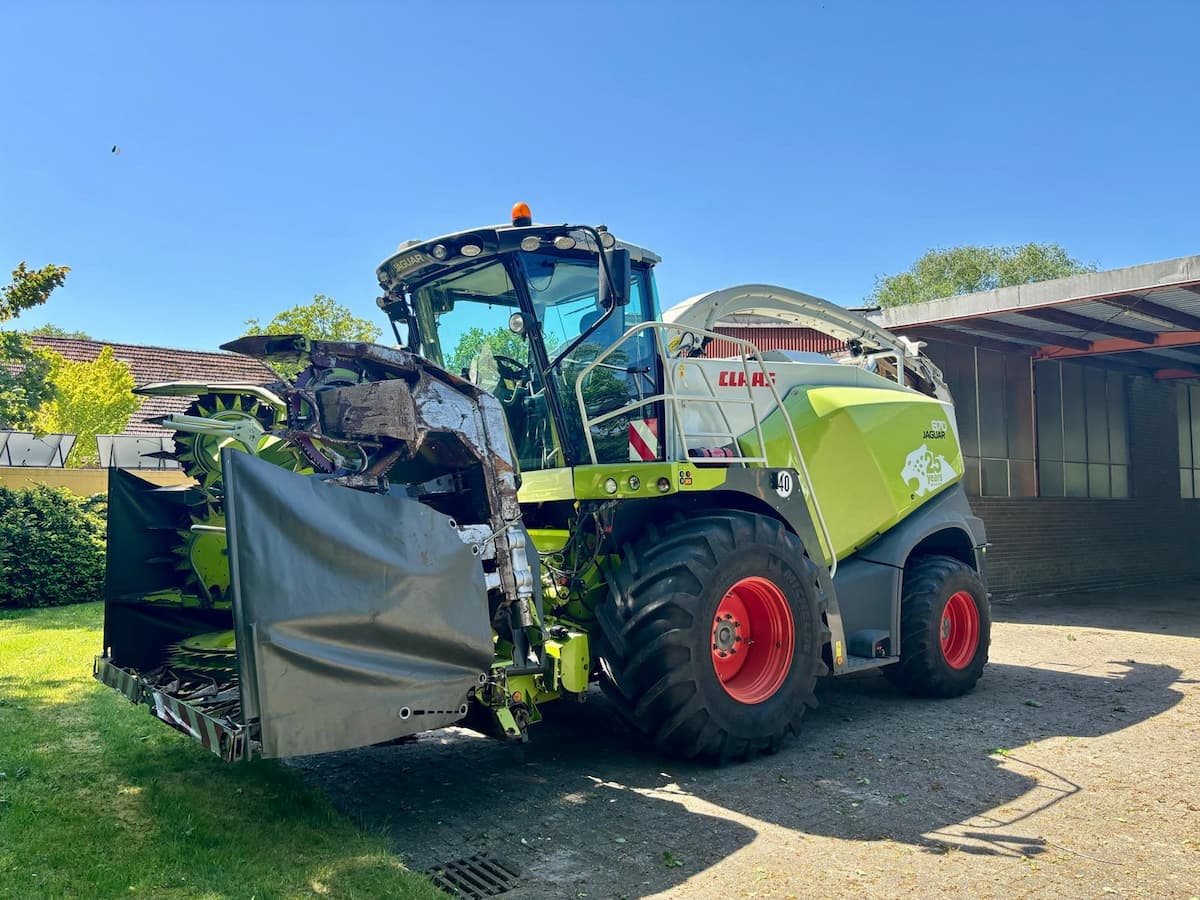
CLAAS JAGUAR 870 4WD with ORBIS 600 and PU 300: a 585 hp forage harvester for maize and grass silage
03.09.2026
CLAAS JAGUAR 870 4WD
The CLAAS JAGUAR 870 4WD with ORBIS 600 and PU 300 Profi Contour is a 585 hp self-propelled forage harvester supplied with an eight-row maize header and a grass pick-up. The machine dates from 2018, shows 3,500 engine hours and 2,700 cutterhead hours, and is offered at 390,970 BGN excluding VAT. The outfit covers the whole forage season, lifting mown and wilted grass from the swath in spring and chopping maize in late summer, without buying a second front attachment.
In short: this 2018 CLAAS JAGUAR 870 4WD runs a Mercedes-Benz OM 473 LA engine of 15.6 litres producing 430 kW (585 hp), drives all four wheels and travels at up to 40 km/h. The package includes an ORBIS 600 eight-row maize header, a PU 300 Profi Contour pick-up, a V-CLASSIC 28 cutterhead and a MULTI CROP CRACKER CLASSIC L with 125/125 teeth. Price 390,970 BGN excluding VAT.
Contents
- Full specification of this machine
- The forage volume that justifies 585 hp
- ORBIS 600: what a row-independent header changes
- PU 300 Profi Contour: the grass silage pick-up
- Why 3,500 engine hours and 2,700 cutterhead hours are different numbers
- Silage quality: chop length and grain processing
- CAM PILOT, AUTO FILL and the PROFI CAM monitor
- What an hour on a harvester of this size costs
- When owning beats hiring a contractor
- What to inspect on a used forage harvester
- The alternatives: smaller machine, older JAGUAR or contract work
- Frequently asked questions
- Viewing and enquiries
Full specification of this machine
The JAGUAR 870 sits in the upper middle of the JAGUAR 800 range and is built for farms that make silage on their own schedule. The table below lists the figures from the listing.
| Item | Specification |
|---|---|
| Model | CLAAS JAGUAR 870 4WD |
| Year | 2018 |
| Engine hours | 3,500 |
| Cutterhead hours | 2,700 |
| Engine | Mercedes-Benz OM 473 LA, 15.6 l, six-cylinder |
| Power | 430 kW / 585 hp |
| Drive | 4-TRAC, all-wheel drive |
| Top speed | 40 km/h |
| Tyres | 800/65 R32 on the drive axle, 600/65 R26.5 on the steering axle |
| Cutterhead | V-CLASSIC 28, automatic shear bar adjustment |
| Kernel processor | MULTI CROP CRACKER CLASSIC L, 125/125 teeth, electro-hydraulic roller-gap adjustment |
| Power management | DYNAMIC POWER |
| Silage additive | system with a 375 l tank |
| Additional fuel tank | 300 l |
| Ballast | 850 kg base weights plus two 340 kg plates |
| Central lubrication | fitted |
| Maize header | ORBIS 600, 600 cm working width, eight rows, AUTO CONTOUR, three-speed gearbox, AUTO PILOT preparation |
| Pick-up | PU 300 Profi Contour, 300 cm width, ground contour following, three-speed gearbox, hydraulic auger lift |
| Guidance | CAM PILOT, AUTO PILOT module, CRUISE PILOT preparation |
| Trailer filling | AUTO FILL with OPTI FILL spout control |
| Monitor | PROFI CAM with AUTO FILL |
| Cab | A/C MATIC climate control, air suspended seat |
| Lighting | LED Plus work lights, LED spout lighting |
| Price | 390,970 BGN excluding VAT |
Current status, photographs and the complete equipment list are on the listing for the CLAAS JAGUAR 870 4WD with ORBIS 600 and PU 300 in stock.
The forage volume that justifies 585 hp
A 585 hp forage harvester with an eight-row header handles somewhere between 500 and 1,000 hectares of silage maize a season, depending on yield, haulage distance and how well the transport is organised. This is a machine for large livestock units, for biogas plants, and for businesses that chop as a service.
Daily output in maize
With the transport running smoothly, yields around 35 to 45 tonnes of fresh matter per hectare and a run of under 5 km to the clamp, a machine of this size does between 30 and 60 hectares a day. The bottleneck is almost never the harvester itself; it is the number of trailers and the rate of consolidation in the clamp.
When the machine is simply too big
It rarely pays on a farm working around 200 hectares of silage maize a year or less. At that scale the annual hours are usually too few to carry the depreciation, and hiring a contractor or buying a smaller model works out sounder. The wider choice between grain and forage machinery is set out in the article on the differences between a forage harvester and a combine harvester.
Why 4-TRAC matters
All-wheel drive is not a luxury in silage maize. The campaign often falls in a wet spell, and a machine weighing over 11 tonnes with a header hanging off the front sinks quickly in soft ground. 4-TRAC keeps it moving and holds a line on slopes, which decides the season for farms in hilly country.
ORBIS 600: what a row-independent header changes
The ORBIS 600 is a rotary maize header with a 6 metre working width that cuts stems regardless of row direction or row spacing. That independence is the key difference against row units, which have to match the drill spacing exactly.
The practical gain
A rotary header works equally well at 70 cm and 75 cm row spacing, in cross drilled crops and in lodged maize. There is no need to reconfigure the machine field by field, and nothing is lost to misalignment with the rows. In flattened crops the difference in harvested tonnage against a row unit is substantial.
AUTO CONTOUR and why ground following saves knives
AUTO CONTOUR holds a constant cutting height relative to the ground through automatic adjustment. Two effects are measurable: less soil in the clamp, which improves fermentation, and slower knife wear. Soil in the crop is the main reason cutting edges dull early and the main reason silage quality slips.
The three-speed gearbox
The header gearbox lets you match disc speed to the state of the crop. In dense, tall maize the lower speeds cut load and fuel; in thin or lodged crops the higher speeds improve feeding. If you are weighing up front attachments, the headers and adapters category is worth a look alongside this machine.
PU 300 Profi Contour: the grass silage pick-up
The PU 300 Profi Contour is a 3 metre pick-up for lifting mown and wilted crop from the swath. With it, the same machine makes lucerne and grass silage instead of standing idle until the maize is ready.
Ground following on the pick-up
The Contour system lets the pick-up follow undulations without scooping soil. That matters most in lucerne, where contaminated crop spoils fermentation and raises the risk of butyric fermentation in the clamp.
The hydraulic auger lift
Hydraulic lift on the feed auger lets the operator respond to a change in swath thickness without stopping. A heavy swath calls for a raised auger to avoid blockage; a thin one feeds better with the auger lower.
Swapping between header and pick-up
Changing the front attachment on a JAGUAR is a quick job given a level yard and a header transport trolley. Plan it in advance, because carrying both a 6 metre header and a 3 metre pick-up means finding covered storage for each, out of direct sun and rain.
Why 3,500 engine hours and 2,700 cutterhead hours are different numbers
Forage harvesters carry two counters that measure different things. Engine hours cover everything the engine runs through, road travel and idling included, while cutterhead hours, often listed as drum hours, count only time with the cutterhead engaged. The gap between 3,500 and 2,700 shows how much of the machine's life went into actual chopping.
What a 77 percent ratio tells you
On this machine cutterhead hours are roughly 77 percent of engine hours. The ratio is descriptive rather than a verdict: a high figure suggests short idle periods, a low one more time spent travelling, typically where fields are scattered. On its own it proves neither good nor poor operation and should be read alongside the service file.
Service life remaining
The engine is rarely the constraint on a forage harvester at this reading, provided maintenance has been regular. What decides the cost of getting it ready are the cutterhead, the pre-compression rollers, the accelerator and the rolls of the MULTI CROP CRACKER fitted to it. A forecast of remaining life comes from the documents and the inspection, not from the hour meter.
Which counter sets the price
When valuing a forage harvester, cutterhead hours carry more weight than engine hours, because they determine wear on the cutting system and the header drive. A machine with 3,500 engine hours and 3,200 cutterhead hours is a different proposition from one with 3,500 and 2,700, even though the engine counter reads the same.
Silage quality: chop length and grain processing
Three settings decide silage quality: chop length, the degree of kernel damage and the cleanliness of the crop. The machine influences all three directly, and a mistake in setting them costs more than the price difference between two harvesters.
Chop length by purpose
For maize silage fed to dairy cows, chop length in common practice runs between 8 and 20 mm, with the longer settings used where the ration is short of physically effective fibre. Biogas feedstock is chopped shorter, because the aim is rapid fermentation rather than rumen structure. Length is set through the number of knives and the speed of the feed rollers. This machine runs a V-CLASSIC 28 cutterhead, meaning 28 knives, which offers a wide set of chop lengths across forage applications. Read the exact figures from the manufacturer's table for the configuration in question.
Kernel processing
In maize at the milk to dough stage, every kernel that passes through whole is feed value thrown away. That is why a cracker sits between the cutterhead and the accelerator on maize work. This machine carries a MULTI CROP CRACKER CLASSIC L with 125/125 teeth and electro-hydraulic roller-gap adjustment, so the gap is changed from the cab without stopping and without tools. In practice the setting can follow the crop as it ripens through the day rather than being corrected at the end of it.
Crop cleanliness
Cutting height is the trade between yield and quality. A higher cut leaves crop in the field but reduces soil and nitrate in the lower stem. A lower cut adds tonnage and, on uneven ground, adds soil. Field losses in maize are not confined to the grain harvest, and cutting height is the single setting where an operator gives away the most value in a silage crop.
CAM PILOT, AUTO FILL and the PROFI CAM monitor
The electronic systems on this machine solve two different problems: steering while working with the pick-up, and filling the trailer. Both feed straight into output per shift and into how tired the operator is by the end of it.
What CAM PILOT does
CAM PILOT is a camera-based guidance system that recognises the swath ahead of the pick-up and corrects the machine's steering. CLAAS describes it as working with 3D cameras and following the swath at speeds up to 15 km/h. The payoff sits squarely in grass silage: the operator stops spending attention on holding the line and the pick-up takes the swath across its full width on every pass.
Guidance in maize is a separate question
The ORBIS header is row-independent, so in maize the steering is a comfort question rather than a source of lost crop. A different system handles it: this machine carries an AUTO PILOT module and the ORBIS 600 itself is prepared for AUTO PILOT. CLAAS guides through maize using row sensors, so confirm during the inspection that the sensor hardware is fitted and live on this particular header. CAM PILOT stays the swath solution for the pick-up.
What AUTO FILL does
AUTO FILL aims the spout at the trailer automatically and spreads the crop evenly along its length, with OPTI FILL refining the spout control itself. The benefit is twofold: less crop spilled on the headland and fuller loads, which means fewer runs to the clamp. Separately, DYNAMIC POWER matches engine output to the load of the moment, which tells most in an uneven crop.
Why this matters in contract work
A contractor's operator changes field and conditions several times a day. Automation keeps the quality of work steady regardless of fatigue late in the shift. It is also an argument in rate negotiations, because the efficiency shows up directly in hectares covered per day.
What an hour on a harvester of this size costs
Hourly cost on a 585 hp machine comes down to fuel, cutting system wear and depreciation. Everything else is small change by comparison.
Fuel
Unlike a tractor, a forage harvester works at high and almost constant engine load. Real consumption in maize is markedly higher than in grass, because both the tonnage per hectare and the resistance at the drum are greater. Keep an adequate supply at the field, because stopping to refuel at this rate of output is expensive time.
Knives, shearbar and rolls
Cutterhead knives and the shearbar are the main wearing items. Sharpening is a daily job during the campaign, and replacement intervals depend on how clean the crop is. This machine has automatic shear bar adjustment, which takes part of the manual work out of the daily routine. Working in dirty conditions can shorten the life of a knife set several times over. Have a spare set ready before the season: spare parts for forage harvesters and headers are ordered by part number, which avoids delivery surprises.
Depreciation
At 390,970 BGN excluding VAT and a planned 300 cutterhead hours a season, depreciation per hour is a heavy line. At 600 hours a season the same sum per hour halves. The decisive question with a forage harvester is therefore not the purchase price but the annual workload you can secure.
When owning beats hiring a contractor
Owning a forage harvester pays when annual workload is high enough and when the harvest window is critical to the business. The two factors work together and rarely apart.
The argument about the window
Silage maize has a short window of optimum maturity, measured in days. With a contractor, the order of service is set by the contractor rather than by your field. If a delay costs you silage quality, the loss in milk yield across the whole year can exceed everything the contract saved.
The argument about extra income
A 585 hp machine carrying two front attachments can work for neighbouring farms once your own ground is cleared, turning a capital cost into a revenue earning asset. That said, it requires a stock of spare parts, a trained operator and reliable haulage.
When hiring still wins
On a small acreage with no prospect of contract work, hiring often comes out cheaper. The sum does not close on hectares alone, though: it turns on the contract rate, the annual hours, the financing, the residual value and the cost of missing the optimum window. Where hiring does win, the sounder investment is in transport and in clamp consolidation, which is where most of the quality is lost.
What to inspect on a used forage harvester
Inspecting a forage harvester differs from inspecting a combine, because the critical assemblies are different. Work through this order on site.
- Open the drum housing and look at the knives for uneven wear and impact damage from foreign objects.
- Check the shearbar for burnt patches and correct geometry along its full length.
- Inspect the pre-compression rollers for bearing play and deformation.
- Check the cracker: tooth profile, remaining roll diameter and the operation of the electro-hydraulic gap adjustment.
- Examine the accelerator and the inside of the spout for abrasive thinning.
- Run the ORBIS header unloaded and listen for uneven noise from the gearboxes.
- Look over the header knives and discs, and the anti-wrap rings.
- Check the PU 300 for broken tines and the condition of the driveline coupling.
- Test the guidance and AUTO FILL in real conditions, not just on the display.
- Ask for the service file and the record of oil and filter changes.
A machine that has worked mainly on light soils with good ground following shows appreciably less wear on the cutting system. Ask not only about hours, but about the conditions those hours were worked in.
The alternatives: smaller machine, older JAGUAR or contract work
The decision is normally between three routes rather than between specific models. The table compares them on the criteria that actually settle it.
| Criterion | JAGUAR 870, 2018, with ORBIS 600 and PU 300 | Smaller self-propelled machine | Contractor |
|---|---|---|---|
| Initial investment | 390,970 BGN excl. VAT | lower | none |
| Control of the harvest window | full | full | set by the contractor |
| Daily output | high | moderate | depends on their machine |
| Ready for grass and maize | yes, both attachments included | usually needs a second attachment | yes |
| Income from contract work | yes | limited | no |
| Demands on haulage | high | moderate | usually negotiated |
| Indicative scenario | high annual volume and/or contract work | moderate annual volume | limited own volume and few annual hours |
For a smaller forage operation the comparison against a mounted machine is instructive, and the guide to the Kemper Champion 1200 mounted forage harvester covers where that route makes sense.
Frequently asked questions
What does the CLAAS JAGUAR 870 with ORBIS 600 and PU 300 cost?
The listed price for this outfit is 390,970 BGN excluding VAT. It covers the 2018 self-propelled machine with 3,500 engine hours, the ORBIS 600 eight-row maize header and the PU 300 Profi Contour pick-up. Payment terms, delivery and any additional equipment are agreed on enquiry.
How much can a 585 hp forage harvester cut in a day?
The practical range is 30 to 60 hectares per shift, but the figure is set by logistics rather than by the harvester. If one trailer takes 25 minutes to return while the machine fills it in eight, you need three or four outfits to keep it moving. Work out the haulage and the clamp capacity before the purchase, not the drum output.
What is the difference between engine hours and cutterhead hours?
Engine hours record all running time, including road travel and idling. Cutterhead hours record only the time with the cutterhead engaged, which is the actual chopping. On this machine the ratio is 2,700 to 3,500 hours, which indicates organised work with little wasted movement.
Can the JAGUAR 870 handle both grass and maize?
Yes, which is exactly why the outfit includes two front attachments. The ORBIS 600 header is used for silage maize and whole crop, while the PU 300 Profi Contour pick-up lifts mown and wilted lucerne and grass from the swath. Swapping attachments takes a level yard and a trolley for the header.
Why choose a rotary header over a row unit?
Flexibility is the main reason. One rotary header serves fields drilled to different spacings and needs no reconfiguration when you move on, which saves time in a short campaign. A row unit is tied to one spacing and copes less well with crops flattened by wind or hail.
Which spare parts are replaced most often on a forage harvester?
Drum knives and the shearbar come first, followed by the knives and discs on the maize header. The cracker rolls are reground or replaced according to the remaining profile. A spare set should be on the shelf before the campaign starts rather than ordered during it.
Viewing and enquiries
The machine is available for inspection and a working test by appointment. Agritec also lists its harvesting machinery in stock and the wider range of used agricultural machinery, so comparable machines can be seen on the same visit. For questions on the equipment, the condition of the cutting system or the terms of sale, use the contact details on the site.