
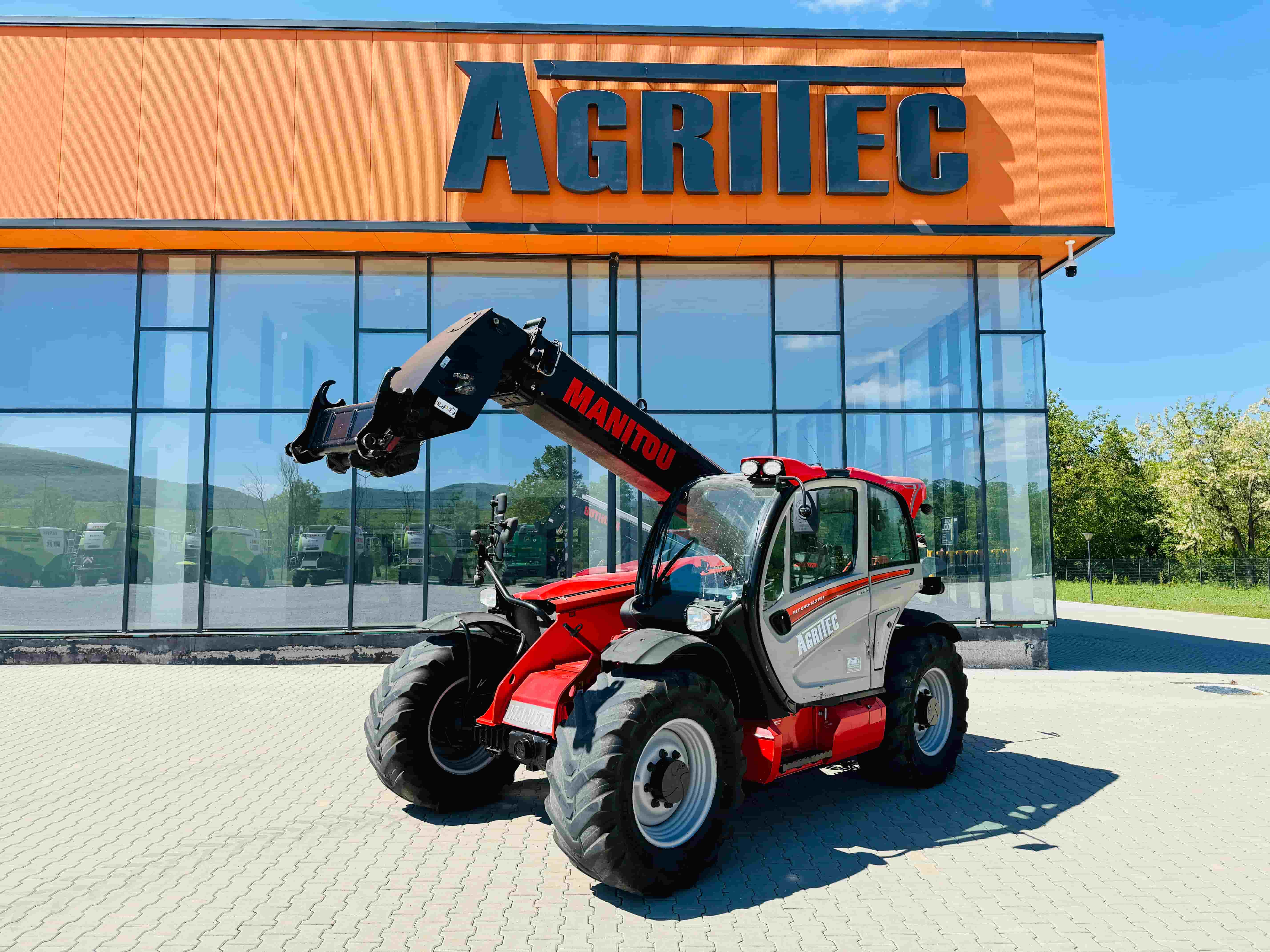
Used telehandler: MANITOU MLT 840-145 versus MLT 735-120
05.10.2026
Used telehandler MANITOU MLT
A telehandler works every week of the year rather than for one campaign, which is why choosing between two used machines is rarely settled on price. Two MANITOUs are in stock with 59,100 BGN between them: the MLT 840-145 PS+ ELITE lifting to 7,550 mm and the MLT 735-120 LSU TURBO POWERSHIFT lifting to 6,860 mm. This article sets out what the price difference actually buys and which machine suits which kind of yard.
In short: the MANITOU MLT 840-145 PS+ ELITE is rated at 4,000 kg maximum capacity, 7,550 mm maximum lift height and 200 l/min of hydraulic flow, and is listed at 129,000 BGN excluding VAT. The MLT 735-120 is rated at 3,500 kg, 6,860 mm and 149 l/min, at 69,900 BGN excluding VAT. The two maxima are not reached at the same time: the permitted load at a given height and reach is read from the machine's load chart.
Contents
- The two machines side by side
- Which of the three numbers settles the choice
- Why capacity at full reach matters more than maximum capacity
- Hydraulic flow and why it matters
- Powershift versus Powershift Plus
- How to read the hour meter on a telehandler
- What a telehandler actually does through the year
- When a telehandler replaces a tractor with a front loader
- Attachments and what they demand of the machine
- What an hour of work costs
- What to inspect on a used telehandler
- Which of the two for which farm
- Frequently asked questions
- Viewing and enquiries
The two machines side by side
Both machines are the same idea from two different generations and two price brackets. The table lists the figures from each listing so the gaps read at a glance.
| Item | MLT 840-145 PS+ ELITE | MLT 735-120 LSU TURBO POWERSHIFT |
|---|---|---|
| Year | 2019 | 2011 |
| Engine hours | 3,350 | 3,950 |
| Engine | John Deere, 4.5 l, four-cylinder, Stage IV | PERKINS, 4.4 l, four-cylinder |
| Power | 104 kW / 141 hp | 91 kW / 124 hp |
| Transmission | Powershift Plus, 5 forward / 3 reverse | POWERSHIFT, 6 forward / 3 reverse |
| Top speed | 40 km/h | 36 km/h |
| Hydraulics | axial piston pump with load-sensing valve, 200 l/min, 270 bar | axial piston pump with load-sensing valve, 149 l/min, 270 bar |
| Maximum lift height | 7,550 mm | 6,860 mm |
| Maximum capacity | 4,000 kg | 3,500 kg |
| Capacity at full reach | 1,450 kg | not stated in the listing |
| Drawbar pull | 9,300 daN | 8,770 daN |
| Tyres | 460/70 R24 MICHELIN | 460/70 R24 MICHELIN |
| Dimensions (L x W x H) | 5,370 x 2,390 x 2,390 mm | 5,000 x 2,390 x 2,390 mm |
| Weight | 8,054 kg | 6,810 kg |
| Turning radius | 3.74 m | not stated in the listing |
| Central lubrication | fitted | not stated in the listing |
| Cab | air conditioning, heating, heated rear screen, air-suspended seat | air conditioning, heating |
| Also included | pallet forks, self-cleaning radiator, automatic hitch coupling, electric mirrors | pallet forks, hook hitch with hydraulic locking, rear hydraulic line, self-cleaning radiator |
| Price excluding VAT | 129,000 BGN / EUR 65,990 | 69,900 BGN |
Both listings, with photographs, are on the pages for the MANITOU MLT 840-145 PS+ ELITE and the MANITOU MLT 735-120 LSU TURBO POWERSHIFT. Confirm year and hours against the machine's own records at the inspection, as you would with any used purchase.
Which of the three numbers settles the choice
Three figures decide a telehandler and almost never all three at once: lift height, lifting capacity and hydraulic flow. Each answers a different job in the yard, so start from the job rather than from the machine.
Lift height: 6,860 mm versus 7,550 mm
Lift height is the number that most often closes the deal. The 690 mm gap looks trivial on paper and decides the work in practice: whether you can tip into a high-sided trailer, whether you clear a clamp wall, and how many rows of bales you stack. Below 7 metres, loading a tall trailer becomes an exercise in precision; above 7.5 metres the same job is routine.
Capacity: 3,500 kg versus 4,000 kg
The 500 kg gap tells in bales and palletised goods. A large round bale can pass 700 kg when damp, and a bulk bag of fertiliser runs around a tonne. The question is not whether you can lift one tonne, but whether you can lift two at once without working at the edge of the load chart.
Power: 124 hp versus 141 hp
Engine power on a telehandler serves two jobs at the same time, driving and the hydraulics. In continuous loading it does both at once, so 17 horsepower shows up mainly in cycle speed rather than in lifting force.
Why capacity at full reach matters more than maximum capacity
Capacity at full reach is the truer guide than maximum capacity, which is achieved with the boom retracted and is the most optimistic figure in any listing. Real work happens with the boom out, and there the numbers fall sharply: the MLT 840-145 is listed at 1,450 kg at full reach versus 4,000 kg maximum.
Reading the load chart
Every telehandler carries a load chart relating reach, height and permitted load. The point you work at most often is almost never the point of maximum capacity. Before comparing two machines, decide the height and reach you will use daily, and compare those values.
Stability and weight
8,054 kg versus 6,810 kg is more than a fuel figure. The heavier machine is steadier with the boom out, but it leaves deeper ruts in a wet yard. If most of your work is inside buildings, take the permitted floor loading from the building's own specification rather than judging it by machine weight; with a load and an attachment the total mass is well above the unladen figure.
Turning radius and the width of the yard
A 3.74 m turning radius on the longer machine is good for the class, and both are 2,390 mm wide. Measure the tightest gap the machine will pass through every day before trusting any catalogue figure.
Hydraulic flow and why it matters
Hydraulic flow sets how fast the boom and the attachment work: 200 l/min on the MLT 840-145 versus 149 l/min on the MLT 735-120, both at 270 bar from an axial piston pump with a load-sensing valve. That is a third more oil delivered per minute.
Where it shows
On plain pallet work the difference is small. It shows with attachments that consume oil themselves: a bale grab, a grapple bucket, a sweeper, a mixing bucket. How much it is worth over a shift depends on the attachment and the cycle, so time a loaded cycle on both machines during the inspection rather than reasoning from the flow figure alone.
Load sensing and why it matters on a loader
Load sensing means the pump delivers only the oil the service is asking for. On a machine making short, varied movements all day, that keeps the oil cooler and the fuel figure lower than a fixed-flow system would. Both machines have it.
The rear hydraulic line
The MLT 735-120 is listed with a rear hydraulic line and a hook hitch with hydraulic locking. That is useful if you will tow a trailer or a tanker and want to operate a service at the back. Drawbar pull of 8,770 daN says what the machine can move, but the permitted trailer mass is set by the hitch rating, the braking system and the registration, not by that figure.
Powershift versus Powershift Plus
Both machines use a stepped hydromechanical transmission rather than a stepless one, in two versions: POWERSHIFT with six forward and three reverse speeds on the older machine, and Powershift Plus with five forward and three reverse on the newer.
What to check on site
The listing gives the transmission on the newer machine as Powershift Plus, with five forward and three reverse speeds. Rather than take any description of it on trust, run the scoop, turn, lift and tip cycle on both machines during the inspection. That cycle repeats hundreds of times a day, so it is where a difference between the two would be felt if there is one.
Road speed: 36 km/h versus 40 km/h
Four kilometres an hour sounds like nothing until you move the machine between two sites several times a day. Over 10 km that is about two minutes per trip, which adds up across a season. Whether the higher road speed also comes with a different transmission or braking specification is worth confirming in the machine's documentation rather than assuming.
How to read the hour meter on a telehandler
Hours on a telehandler do not compare directly with the same figure on a tractor, because the machine accumulates them at low speed, with constant shuttling and the hydraulics under load. Two machines with similar readings can be in very different condition depending on the work they did.
The assemblies that decide condition
On a telehandler the critical points are not in the engine but in the boom and its pivots: the telescopic wear pads, the extension cylinder, the pins and bushes in the carriage, the bucket pivots. Worn pads show up as play with the boom extended and as an unusual creak under load.
Why central lubrication has value
The MLT 840-145 is listed with central lubrication. On a machine with dozens of grease points that removes a daily task that is easy to skip. Missed greasing is a known cause of wear in the pivots, so ask for the greasing record as well: the documented history is worth more than the presence of the system on its own.
Emissions standard
The engine in the MLT 840-145 is Stage IV, which means exhaust aftertreatment and a consumable line in the budget. Establish at the inspection what that system consumes and that it has not been tampered with, because putting it right is expensive.
What a telehandler actually does through the year
The telehandler is the hardest-worked machine on a livestock farm, because it runs in the campaign and outside it. That is the main reason to choose it more carefully than a seasonal machine.
Silage and clamp work
During the silage campaign it spreads and consolidates in the clamp; outside it, it cuts silage out for the feeder wagon. Here weight for consolidation and flow for a quick cycle both count.
Manure and bedding
Daily bucket work right through winter. Lift height decides which trailer or spreader you can load, not how much you can lift.
Bales
Collecting from the field, stacking in store, and pulling out through winter. Height decides how many rows you stack; capacity decides whether you carry two bales at a time.
Palletised goods and store work
Loading and unloading seed, fertiliser, chemicals and parts. Extra height gives access to the top of racking and to high-sided lorries.
When a telehandler replaces a tractor with a front loader
A telehandler replaces a tractor and front loader when the work is mostly lifting to height in short cycles. The tractor stays the better machine when the same unit also has to pull and to drive an implement from the PTO.
What you gain
Forward visibility, reach that a front loader cannot give, a shorter cycle, and less overall length when turning in the yard. For a farm lifting above a certain height every day, no amount of extra tractor power substitutes for it.
What you give up
A telehandler is not a tractor. In standard specification it has no category 3 linkage and no PTO, so it does no field work. If you are buying one machine for everything, look first at the used tractors in stock and decide whether field work leads.
Why most farms end up with both
Many operations arrive at a tractor for the field and a telehandler for the yard, because the two do not compete but unload each other. The general criteria for choosing a telehandler are set out separately in the guide to choosing the right telehandler; this article compares two specific machines.
Attachments and what they demand of the machine
The attachment sets the flow and capacity you need more than the job description does. The table gives a guide to the common ones.
| Attachment | What it demands | Note |
|---|---|---|
| Pallet forks | capacity and height | included with both machines |
| Grain and silage bucket | volume matched to capacity | a bigger bucket also needs more counterweight |
| Grapple bucket | an extra hydraulic service and flow | where the 149 and 200 l/min figures separate |
| Bale grab | flow according to the model | take the requirement from the attachment's manual |
| Mixing bucket | high, sustained flow | check compatibility before buying |
| Sweeper | steady flow at low revs | needs the flow reduced |
| Crane jib | the load chart at full reach | maximum capacity does not apply here |
If you already own attachments, take their flow and pressure requirements and check them against both machines before deciding on price.
What an hour of work costs
Hourly cost on a telehandler comes from fuel, tyres, greasing and depreciation, with a boom repair line added on a high-hour machine. A telehandler runs many hours a year, so a small hourly difference accumulates quickly.
Fuel
Consumption depends on the job far more than on the model. Continuous silage and manure work holds the engine high; moving pallets in a store holds it low. The figure for your own yard is measured over one shift rather than taken from a catalogue.
Tyres
Both machines run 460/70 R24 MICHELIN. Telehandler tyres wear fast because the machine turns on the spot on concrete and hardcore. Check production dates and tread depth, because a set of tyres is a meaningful line.
Depreciation and residual value
The 59,100 BGN gap spreads across the years you will keep the machine. A newer machine with fewer hours normally resells for more, though the figure you actually get depends on the market when you sell; the older one has the lower entry price and less value left to lose. Which is better depends on whether you are buying for three years or for ten.
Planned repairs
On a higher-hour machine, budget in advance for telescopic wear pads and pivot bushes. Boom work is predictable when planned and expensive when it lands in the busiest month. A seasonal schedule helps, and the service plan for tractors, loaders and implements sets the checks out by season.
What to inspect on a used telehandler
Inspecting a telehandler differs from inspecting a tractor, because the main risk sits in the boom. Work through this order on site.
- Extend the boom fully and check for play by pushing the load down and sideways.
- Look at the telescopic wear pads through the access openings for signs of metal-to-metal contact.
- Check the extension cylinder for scoring and for oil on the chromed section.
- Lift a load, hold it at height and watch whether the boom creeps down. Nobody stands under or within reach of the load, and the duration of the test follows the machine's safety instructions.
- Check the pins and bushes on the carriage and the bucket for play.
- Run every hydraulic service unloaded and under load, the auxiliary line included.
- Shuttle through all gears forward and back and watch for hesitation on the reverse.
- Test the frame levelling system if the machine has one.
- Look underneath the chassis for weld repairs and deformation, especially around the front axle.
- Ask for the service file and check that greasing intervals were kept.
On any machine with high hours, expect signs of work. What matters is whether the wear is even and whether there are records, not whether wear exists.
Which of the two for which farm
The decision comes down to a few concrete situations rather than to a general verdict on which telehandler is better.
| Situation | Better suited | Why |
|---|---|---|
| Loading high-sided trailers daily | MLT 840-145 | 7,550 mm versus 6,860 mm of lift |
| High daily throughput with a hydraulically driven attachment | MLT 840-145 | 200 l/min versus 149 l/min of flow in reserve |
| Limited budget, mostly bucket work | MLT 735-120 | lower entry price for the same core function |
| Keeping the machine more than five years | MLT 840-145 | 2019 build and 3,350 hours, with a confirmed service record |
| A second machine for peak periods | MLT 735-120 | less capital tied up in a machine with few annual hours |
| Working on an old concrete floor indoors | MLT 735-120 | 6,810 kg versus 8,054 kg unladen, once the permitted floor loading is confirmed |
| Towing a trailer around the yard | either | 8,770 and 9,300 daN of drawbar pull, with a suitable hitch and braking system |
To compare against other machines in the class, the full list is in the used agricultural machinery in stock.
Frequently asked questions
What does a used telehandler cost?
The two machines in stock show the working range for this class: from about 70,000 to 130,000 BGN excluding VAT. Year, hours, lift height and the attachments included are what place a machine within that band. The gap is rarely explained by the model year alone.
How much lift height do I need?
Measure the highest point you load into regularly and add clearance for the attachment itself. For high-sided trailers and for stacking bales several rows deep, the usual starting point is 7 metres upwards. Below that the work is possible but takes more precision and more manoeuvring.
Why does maximum capacity not apply with the boom extended?
Because the centre of gravity moves away from the machine. The further out the load sits, the greater the tipping moment, so the manufacturer derates the permitted load along the whole length of extension. The ratio between the two extremes on this machine is roughly one to three, which is usual for the class rather than a shortcoming of this particular loader.
How many hours is too many on a telehandler?
There is no single figure. Hours accumulate at low speed on these machines, so the condition of the boom, the wear pads and the pivots tells you more than the meter. A machine with documented greasing and even wear can work reliably at a reading that would worry you on paper.
Can a telehandler replace a tractor?
Not entirely, and the reverse does not hold either. The telehandler takes over the lifting and the short cycles, but it will not pull a plough or drive an implement, so it does not stand in for the field machine. If you can only buy one, the ratio of yard hours to field hours decides it, not the specification sheet.
What hydraulic flow does a bale grab need?
Take the exact requirement from the attachment's own manual, because it varies considerably between models. The general rule is that an attachment with its own hydraulic services can work faster on higher flow, but only if the attachment and its control block are sized for it. That is why the gap between 149 and 200 l/min shows up on such an attachment rather than on plain pallet forks.
Viewing and enquiries
Both machines are available for inspection and a working test by appointment, which is the quickest way to settle which machine suits your yard. Agritec also supplies spare parts for loaders and implements, ordered by part number. For questions on specification or attachments, use the contact details on the site.