
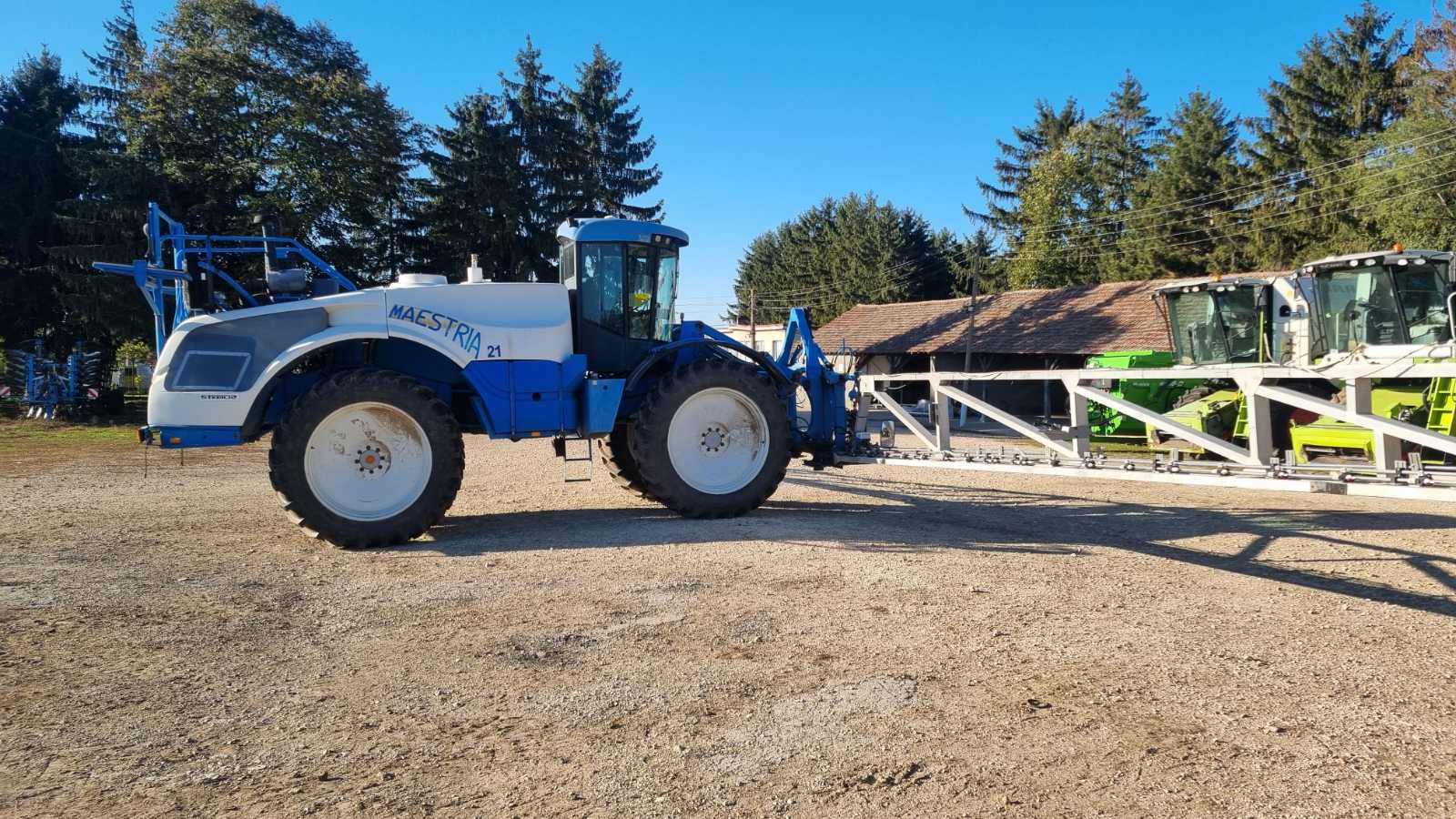
Used self-propelled sprayer: MATROT MAESTRIA 21/B and what to check before you buy
20.10.2026
Used self-propelled sprayer MATROT MAESTRIA 21/B
A used self-propelled sprayer makes sense when you treat several thousand decares and your tractor is needed for other jobs in the same window. The decision comes down to three things: the condition of the pump and boom, the periodic inspection paperwork, and whether the track width and ground clearance suit the crops on your farm. Our example is a 2011 MATROT MAESTRIA 21/B with a 4,000 L tank, a 36 m boom and a 211 hp DEUTZ engine.
Key points
- With a 4,000 L tank and a 36 m boom, a self-propelled sprayer covers about 200 decares (20 ha) per fill at 20 L/daa, so real output depends heavily on how refilling is organised.
- The second set of narrower tyres allows work in row crops as well, but only if the machine's track width and clearance match the row spacing and growth stage of the crop.
- In Bulgaria, self-propelled, trailed and mounted sprayers must be inspected every 3 years under Ordinance No. 5 of 2016, and the State Fund Agriculture requires the certificate for several eco-schemes.
- During inspection, the boom, pump and suspension deserve the most attention: repairs there cost far more than cosmetic defects.
Contents
- Self-propelled, trailed or mounted sprayer
- MATROT MAESTRIA 21/B: machine specifications
- What 4,000 L and 36 m mean in the field
- Two sets of tyres: cereals and row crops
- Inspecting a used self-propelled sprayer
- Documents and requirements in Bulgaria
- In-season maintenance and winter storage
- The sprayer within your machinery fleet
- Price and enquiries for the MATROT MAESTRIA 21/B
- Frequently asked questions
Self-propelled, trailed or mounted sprayer
A self-propelled sprayer is a machine with its own engine, cab, chassis and tank that works without a tractor. It pays off on large areas with tight application windows, when spraying has to be done in 1-2 days rather than a week. On a small farm, a trailed sprayer is usually the more sensible investment.
The difference is not just tank size. Self-propelled machines usually offer higher ground clearance and adjustable track width, which allows work in row crops at later growth stages, provided the specific machine suits the crop. They also free up the tractor for drilling, fertilising or tillage during the same period.
| Criterion | Mounted | Trailed | Self-propelled |
|---|---|---|---|
| Tractor required | Yes, at all times | Yes, at all times | No |
| Tank | Small | Medium to large | Large (MAESTRIA 21/B: 4,000 L) |
| Late-stage work in row crops | Limited | Depends on tractor clearance | Usually higher clearance and adjustable track width |
| Investment and upkeep | Lowest | Medium | Highest: engine, transmission, cab |
The takeaway: a self-propelled sprayer usually makes sense on several thousand decares with a full machinery schedule, while on smaller areas a trailed machine is most often the better value.
MATROT MAESTRIA 21/B: machine specifications
MATROT is a French sprayer manufacturer founded in 1959 and today a brand of the EXEL Industries group, alongside Hardi, Berthoud and Evrard. The MAESTRIA series is the brand's self-propelled line, aimed at large arable farms. In the model designation, 21 corresponds to a power class of around 210 hp, which matches the 155 kW of this machine.
| Specification | MATROT MAESTRIA 21/B |
|---|---|
| Year of manufacture | 2011 |
| Engine hours | 5,147 |
| Engine | DEUTZ, 6-cylinder |
| Power | 155 kW (211 hp) |
| Tank | 4,000 L |
| Working width | 36 m |
| Tyres | Michelin, 4 x 480/80 R50 plus a second set of 4 tyres, 380 mm wide |
| Equipment | Air conditioning, 2 cameras |
5,147 engine hours over 15 seasons averages roughly 340 hours a year. The number alone does not tell you the conditions the machine worked in, so what has been replaced on the pump, boom and chassis matters more. The full listing and photos are on the MATROT MAESTRIA 21/B page, where you can also request the service history.
What 4,000 L and 36 m mean in the field
A 36 m boom covers 36 decares (3.6 ha) for every kilometre travelled, and 4,000 L of spray mix covers 133 to 267 decares depending on the application rate. These two figures determine how many times a day you refill and how much time you lose at the field edge.
| Application rate | Area per tank (4,000 L) |
|---|---|
| 15 L/daa (150 L/ha) | about 267 daa (26.7 ha) |
| 20 L/daa (200 L/ha) | 200 daa (20 ha) |
| 30 L/daa (300 L/ha) | about 133 daa (13.3 ha) |
At a working speed of 12 km/h, theoretical output is 432 daa/h (43.2 ha/h), but real output is noticeably lower because of headland turns, refilling and wind stoppages. A significant share of the day often goes on travelling to water and refilling. That is why self-propelled operations plan refilling at the field edge from a bowser, and suitable trailers and tankers can cut downtime more than a higher working speed.
The 36 m width also affects tramlines. Planning is easiest when the drill width divides evenly into 36 m, for example 3, 4, 6, 9 or 12 m, and the fertiliser spreader is set to the same tramline spacing. Other layouts are possible with marking or guidance systems, but organisation becomes harder and the risk of the sprayer running over the crop increases.
Two sets of tyres: cereals and row crops
Two sets of tyres widen what the machine can do, but they do not on their own guarantee access to every crop. The wide Michelin 480/80 R50 tyres suit wheat, barley and oilseed rape, where the larger footprint reduces soil compaction. The second set is narrower; the listing gives only a width of 380 mm, without the full size.
Whether the sprayer can work in maize or sunflower depends on three things at once: track width, ground clearance and crop growth stage. With 70 cm row spacing, which is standard in Bulgaria, the wheels must run exactly between the rows, and clearance must be sufficient for crop height at the time of application.
Track width on the MAESTRIA series is adjustable, with a range of 1.80 to 2.45 m quoted for the series. Before buying, check on site how far this particular machine adjusts and whether it matches the row spacing of the precision seed drills on your farm. Confirm the exact size of the narrow tyres when you enquire, since both clearance and passage between rows depend on it.
Inspecting a used self-propelled sprayer
Inspecting a self-propelled sprayer has two parts: the machine and the spraying system. The general rules for choosing used equipment apply here too, but on a sprayer the most expensive defects hide in the boom and the hydraulics.
Engine and chassis
Check the DEUTZ engine like any diesel: cold start, smoke under load, leaks and temperature after 20-30 minutes of running. On a self-propelled sprayer, look for leaks on the hydraulic drive and wheel suspension, because the machine often works with a full tank of 4 tonnes of liquid. Also test the steering on a full-lock turn.
Tank, pump and induction hopper
The pump is the heart of the system. In a water test, pressure should stay stable at different engine speeds, with no pulsation and no air in the system. Inspect the tank for cracks around the mounting straps, and check the rinse tank and the chemical induction hopper, if fitted.
Boom and suspension
The 36 m boom is the most heavily loaded assembly. Unfold and fold it at least three times: movement should be smooth, with no knocks and no sticking sections. Look for cracks and weld repairs at the hinges, play in the pivots and leaks on the hydraulic cylinders. The suspension must return the boom to level, otherwise the rate varies between the tips and the centre.
Nozzles, filters and sections
Worn nozzles deliver more than their rated flow and give uneven coverage. The most reliable test uses water: collect the output of several nozzles along the boom for one minute and compare it with the manufacturer's chart for the same nozzle type and pressure. If some nozzles deliver more than 10% above a new nozzle, budget for a new set. For filters, seals and nozzles, searching for spare parts by part number helps, because a 36 m boom has dozens of identical positions.
Cab and electronics
The MAESTRIA 21/B has air conditioning and 2 cameras. Check that the cameras give a clear picture during folding and reversing, that the terminal reads speed and rate correctly, and that every section switches on and off from the cab.
A short water test that reveals the most in 30 minutes:
- Partly fill the tank with clean water.
- Start the pump and check pressure at low and high engine speed.
- Unfold the boom and switch on each section one by one.
- Check every nozzle for dripping after the section is switched off.
- Measure the output of several nozzles and compare the figures.
- Fold the boom and check the cylinders and hoses for leaks.
Documents and requirements in Bulgaria
Self-propelled, trailed and mounted sprayers in Bulgaria are subject to periodic technical inspection under Ordinance No. 5 of 3 February 2016 (in Bulgarian). The ordinance does not apply to hand-held equipment or knapsack sprayers. New equipment must be inspected within 5 years of purchase, and since 2020 the interval has been 3 years. Inspections are carried out by teams appointed by order of the Minister of Agriculture; according to 2024 information, the units are based in Ruse and Plovdiv and can inspect the machine on the farm. A successful inspection results in a certificate and a mark on the machine.
An import does not automatically mean a new inspection. Under Article 15, a machine with a valid certificate from the competent authorities of another EU member state may be used in Bulgaria, provided that the time elapsed since the last inspection is no longer than the applicable Bulgarian interval. Once the certificate expires, the requirements of the ordinance apply.
The certificate also has a financial side. The State Fund Agriculture requires it for several interventions, including the eco-scheme for reduced pesticide use and organic crop production. When buying, ask for the document from the last inspection, Bulgarian or foreign, and check its validity before the season.
An imported machine is registered under the Bulgarian Agricultural and Forestry Machinery Registration and Control Act. It is wise to have the origin and ownership documents in order before payment, not after.
In-season maintenance and winter storage
Product residue left in the system can block nozzles and filters and accelerate wear on seals and the pump. After every application, rinse the system, clean the filters and wash the boom down. This costs far less than replacing a pump or clearing blocked nozzles at the height of the season.
Before winter, drain the system completely, run antifreeze through the pump and lines, and grease the boom hinges. Store the machine under cover and check nozzles and seals before spring. A detailed component schedule is in the pre-season service plan, and the general rules on agricultural machinery maintenance apply to self-propelled machines as well.
Calibrate the sprayer before the first application of the season. The required output per nozzle is: flow (L/min) = application rate (L/ha) x speed (km/h) x nozzle spacing (m) / 600. At 200 L/ha (20 L/daa), 12 km/h and 0.5 m nozzle spacing, that gives 2 L/min per nozzle. TeeJet's technical guidance recommends replacement when a nozzle's flow is more than 10% above that of a new nozzle of the same type. Pressure should only be used to fine-tune the rate, not as a substitute for replacing worn nozzles. Calibration takes about an hour, while a 10% rate error across 3,000 decares means product for 300 decares either wasted or missing from the crop.
Working with crop protection products requires personal protective equipment even with a closed cab: the operator is most exposed during filling, mixing and cleaning. The core rules are covered in the article on safety with agricultural machinery.
The sprayer within your machinery fleet
A self-propelled sprayer delivers the most when it is matched to the rest of the fleet. That means three things:
- A tramline layout coordinated with the drills and the fertiliser spreader.
- Guidance and automatic section control, which reduce overlaps with a 36 m boom. More on the options is in the article on GPS technology in agriculture.
- Water and product logistics, so the machine does not wait at the field edge.
Price and enquiries for the MATROT MAESTRIA 21/B
The listed price of the MATROT MAESTRIA 21/B is BGN 78,037 excluding VAT. At the fixed rate of 1.95583, this is approximately EUR 39,900 excluding VAT: a calculated equivalent, not a separately quoted euro price. Current price and availability are confirmed on enquiry. Agritec Ltd is based in Targovishte, Bulgaria, and handles sales and service of agricultural machinery, spare parts and leasing schemes.
A practical sequence:
- Send an enquiry and ask for the exact size of the second tyre set, the service history and the last inspection document.
- Arrange a viewing with a water test following the steps above.
- Agree on transport and, if needed, the leasing scheme.
If you need other machinery for the same season, the used agricultural equipment section lists the available machines, and for questions about this sprayer use the Agritec contact page.
Frequently asked questions
How many decares does one 4,000 litre tank cover?
At 20 L/daa (200 L/ha), one 4,000 L tank covers 200 decares (20 ha). At 15 L/daa the area is about 267 decares, and at 30 L/daa about 133 decares.
How often does a sprayer need to be inspected in Bulgaria?
Under Ordinance No. 5 of 2016, a new sprayer must be inspected within 5 years of purchase and every 3 years after that. The requirement does not apply to hand-held equipment or knapsack sprayers.
Why does a self-propelled sprayer have two sets of tyres?
Wide tyres reduce compaction in cereals and oilseed rape, while narrower ones are for working between the rows of row crops. Whether the machine can enter a particular crop also depends on track width, ground clearance and growth stage.